Transactional Analysis (or TA as it is often called) is a model of people and relationships that was developed during the 1960s by Dr. Eric Berne. It is based on two notions: first that we have three parts or ‘ego-states’ to our ‘personality. The other assumption is that these converse with one another in ‘transactions’ (hence the name). TA is a very common model used in therapy and there is a great deal written about it.
Parent, Adult and Child
We each have internal models of parents, children and also adults, and we play these roles with one another in our relationships. We even do it with ourselves, in our internal conversations.
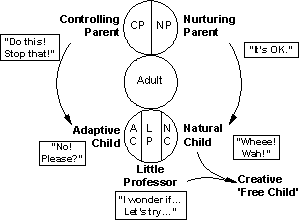
Parent
There are two forms of Parent we can play.
The Nurturing Parent is caring and concerned and often may appear as a mother-figure (though men can play it too). They seek to keep the Child safe and offer unconditional love, calming them when they are troubled.
The Controlling (or Critical) Parent, on the other hand, tries to make the Child do as the parent wants them to do, perhaps transferring values or beliefs or helping the Child to understand and live in society. They may also have negative intent.
Adult
The Adult in us is neither the grown up rational person who talks reasonably and assertively, neither trying to control nor reacting. The Adult is comfortable with themselves and is for many of us, our ‘ideal self’.
Child
There are three types of Child we can play.
The Natural Child is largely un-self-aware and is characterised by the non-speech noises they make. They like playing and are open and vulnerable.
The Little Professor is the curious and exploring Child always trying out new stuff (often much to their Controlling Parent’s annoyance). Together with the Natural Child they make up the Free Child.
The Adaptive Child reacts to the world around them, either changing themselves to fit in or rebelling against the forces they feel.
Communications (transactions)
When two people communicate, each exchange is a transaction. Many of our problems come from transactions that are unsuccessful.
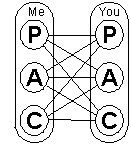
Parents naturally speak to Children, as this is their role as a parent. They can talk with other Parents and Adults, although the subject still may be about the children.
The Nurturing Parent naturally talks to the Natural Child and the Controlling Parent to the Adaptive Child. In fact these parts of our personality are evoked by the opposite. Thus if I act as an Adaptive Child, I will most likely evoke the Controlling Parent in the other person.
We also play many games between these positions, and there are rituals from greetings to whole conversations, such as the weather, where we take different positions for different events. These are often ‘pre-recorded’ as scripts we just play out. They give us a sense of control and identity and reassure us that all is still well in the world. Other games can be negative and destructive and we play them more out of sense of habit and addiction than constructive pleasure.
Conflict
Complementary transactions occur when both people are at the same level. Thus Parent talking to Parent, etc. Here, both are often thinking in the same way and communication is easy. Problems usually occur in Crossed transactions, where the other person is at a different level.
The parent is either nurturing or controlling, and often speaks to the child, who is either adaptive or ‘natural’ in their response. When both people talk as a Parent to the other’s Child, their wires get crossed and conflict results.
The ideal line of communication is the mature and rational Adult-Adult relationship.
So what?
Being a Controlling Parent can get the other person into a Child state where they may conform with your demands. There is also a risk that they will be an Adaptive ‘naughty child’ and rebel. They may also take opposing Parent or Adult states.
Be a Nurturing Parent or a talk at the same level as the other person to create trust.
Watch out for crossed wires. This is where conflict arises. When it happens, first go to the state that the other person is in to talk at the same level.
For rational conversation, move yourself and the other person to the Adult level.
Typical Games
Yes But
Begins with a tale of woe and asking for help; after each suggestion, each is dismissed it with ‘yes but’ or the equivalent of “yes but” and encourages another suggestion. After several rounds the discussion ends with something like ‘Well you weren’t much help, I guess I’ll go to someone who really understands or can help me.’ (Switch from Victim to persecutor)
Poor Me & Stupid
I can’t help myself & I can’t think; begins by displaying helplessness to gain response. Just before responder grows weary and either quits or demands others to think and act responsibly, they switch and discount by saying something like ‘I was wrong thinking you were smart/helpful/loving.’ (Victim to Persecutor.)
Wooden Leg
Game opens by (1) acquiring an infirmity or (2) using an infirmity already acquired as a reason for being helpless or unable to think. You provide help continuously as they subtly demand more and more. When you finally realize what’s happening they switch to a stance of ‘You can’t expect someone with [infirmity] to do … What kind or person are you?’ Commonly played using alcohol as the infirmity. (Victim to Persecutor)
See What You Made Me Do
The game opens with a come-on for advice. You give it. They go off and execute the advice in some fashion and of course get results that are not what they wanted. They come back to you and angrily deliver the switch punch line “See what you made me do!” (Victim to Persecutor)
Kick Me
A series of discounts (or worse) to you. After a while, when you’ve had enough abuse you then wallop them. Which at some Child level was what they wanted; a reaction. Common these days in domestic disputes where one spouse verbally assaults the other, provoking a physical response. (Persecutor to Victim)
If It Weren’t For You I’d be …
A phrase used to persecute until at long last, they leaves the relationship. Without a ready excuse for a happy life now that their other is gone, they may comes face to face with him/herself – the hard-done-by frightened little waif. Persecutor to Victim. Unless he/she is lucky to have friends willing to listen to ‘If it wasn’t for him/her …’ in which case they continue as the persecutor of the missing partner in absentia.
I’m Only Trying To Help You
Opens this game by offering unsolicited advice, or (if matched up with a Yes But or See What You Made Me Do player) in response to a request for advice. The advice is executed with either dire consequences or not the desired results. They then returns to the advice giver complaining; who says ‘I’m only trying to help you.’ (Rescuer to Victim.)
See How Hard I’ve Tried
Similar to I’m Only Trying To Help You, giving advice to another who executes it without success. When they complain; advice giver with indignation, exclaims ‘See how hard I’ve tried’ or ‘After all I’ve done for you.’ (Rescuer to Persecutor)
Most of us unconsciously react to life from a position of victim-hood. Anytime we refuse to take responsibility for ourselves, we are opting to play victim. This leaves us feeling at the mercy of, done in by and un-faired against; no matter what our situation might be.
Yes, but…
The set up: “Hey, help me solve this problem.” When the other person tries to help and offers advice, the response is “Yes, but I could never do that” or “Yes, but I tried that once and it made things worse” and on and on. Every suggestion is shot down (then the helper and the helpee begin to realize they are in a game).
The ulterior motives: to prove that “no one can tell me what to do,” to control the conversation, to picture oneself as being the innocent, suffering, pitiable victim of an insolvable situation, or to demonstrate that “I am superior–I thought of a tough question and found fault with all your answers.”
The payoff: I’m OK (smart and powerful); you’re not OK (wrong every time!).
Rapo
The set up: a couple meet and have a good time together. He tries to impress her; she flirts.
The ulterior motive: after a fun evening, he asks to take her home or to stay the night and she responds, “You creep! What do you think I am? I’m no slut! You are just like all men; all you think about is sex.” Or… he tells her he is in love with her and she sleeps with him, then he dumps her thinking, “Wow, are women dumb! They will believe anything you tell them.”
The pay offs: to put down the opposite sex, to have an ego trip proving one’s attractiveness, to justify one’s anger towards the opposite sex, to avoid sex and/or an intimate, long-term relationship, to project dirty, crude sex to males or desperate needs for love to females, to confirm that I’m OK but you’re not OK.
Now I got you, you SOB (referred to as “NIGYSOB”)
The set up: the game player uses a minor incident, perhaps an oversight or a simple error, to “try to help” the other person do better or to correct some alleged injustice done by the other person.
The ulterior motive: The game player, whose anger has been secretly building for a long time, has been waiting for (or manipulating) an ideal occasion which would justify venting his/her full rage and nailing the other person to the wall. Examples: a rival at work makes mental notes of all your mistakes and then “tries to help you” by publicly criticizing you in front of co-workers and the supervisor. Or… you play NIGYSOB with your boss by finding he/she has made some mistake and then you denounce him/her as being inexperienced or stupid to all your buddies. Or… a jilted ex-lover may confront the former partner about not returning some minor items (say some bed sheets). The tirade takes place in front of the ex-lover’s new partner and many other vitriolic accusations are thrown in: “You screw over people and don’t care… you are the most arrogant, self-centered b _ _ _ _ _ I’ve ever seen….”
The payoffs: As the aggressor, one manufactures an excuse for venting one’s pent-up anger, one can hurt the other person’s reputation, one can avoid recognizing his/her own mistakes and weaknesses by focusing on the other person’s faults, one can build his/her own ego while demonstrating that other people are SOB’s.
If it weren’t for you
The set up: a person, usually in a long-term relationship, wants to explain why he/she has lived the way they have. Example: the teenager with a mediocre school record says, “my parents weren’t interested in school and didn’t make me study.” A middle-aged man says, “I could have been much more successful if I hadn’t had to take care of a wife and family.” A housewife says, “I could have gone to school and had an exciting career if I hadn’t done all these things for my family which no one appreciates.”
The ulterior purpose: to deny responsibility for one’s life, to blame others for the misfortune one experiences, to seek sympathy, to express anger and resentment towards others or the world or God.
The payoff: to prove I’m not responsible, I’m faultless (OK); you are to blame (not OK) and deserve my resentment. This is similar to the game of “See what you made me do.”
Note that many games are repeated over and over again with new victims, i.e. a Rapo or a Yes, but player may go through the same routine hundreds of times, suggesting the game player needs to frequently gain a certain pay off. In TA terms, this is called a “racket,” that is, a need to play certain games and feel a certain way repeatedly–angry, neglected, superior, inferior, cheated, etc. Sometimes game playing leads to “Stamp Collecting,” a TA term for storing up points for feeling bad, e.g. being “dumped,” or for doing good. Then, “Brown Stamps” for being hurt can be cashed in for a guilt-free temper outburst, a week end binge, or some other revenge. “Gold Stamps” for being good can be cashed in for a good time–a shopping spree or a night on the town–which you wouldn’t let yourself do if you hadn’t been so good.
Thus far, we have described games that put down others. There are self-put down games.
Put downs of one’s self
Kick me or drop me
The set up: when we are feeling insecure and unlovable, we might put ourselves down and, indirectly, ask others to reject or hurt us. We might be self-critical and bore others until they leave. We might cling so tightly to our boy/girlfriend that we suffocate them and drive them away. We might be so clumsy or incompetent or insecure that we invite others to poke fun of us. It is as if we put a sign on our backs that says “Kick me.”
The ulterior motive: to feel bad, unloved, rejected, and/or hurt without realizing that we, as “kick me” players, intended for it to happen precisely the way it did. Indeed, most “kick me” players then proclaim their innocence by playing, “Why does this always happen to nice, little me?”
The pay offs: to avoid having others expect us to be responsible and capable, to avoid intimacy, to re-create a loss of parental love, to get sympathy and some enjoyment when we tell others our “ain’t it awful” stories, to deny any responsibility for what happened, to get positive strokes when putting ourselves down (see Sooty Sarah in chapter 6) and negative strokes when we are kicked, to confirm that I’m not OK (“No one likes me”) and/or that you’re not OK (“You can’t trust people”). Hurt feelings earn us “brown stamps” which can be cashed in for many pay offs, like a good sulk, a run-away-from-home, a fight, an affair, a lost weekend on the town, etc.
The “kick me” game is self-defeating, similar to a “gallows transaction” in which a person manages to get his/her friends to laugh and give other forms of attention when he/she makes mistakes, drinks too much, shoplifts, drives dangerously, cheats on a boy/girlfriend or on an exam, etc. In this way, the misguided friends help lead the person to the gallows of self-defeat and misery.
Wooden leg
The set up: “the reason I’m not a fantastic track star is because I have a wooden leg.” “I dropped out of school because my parents were poor and from the wrong part of town.” “I wasn’t promoted because I wasn’t in the right social circles.”
The ulterior motives: to have an excuse for one’s actions, to deny responsibility for one’s own life, to get sympathy.
The pay offs: “surely you wouldn’t expect much from me, considering that I have this handicap–a wooden leg, the wrong parents, the wrong friends, the wrong size, the wrong sex, the wrong age, the wrong race, etc.”
Alcoholism
There are many reasons why people drink or use drugs: to forget problems, to reduce inhibitions and get courage or power, to have an excuse for doing things one wouldn’t ordinarily do, to have social interaction, to get some sexual satisfaction (overt or subtle; heterosexual or homosexual), to hurt the family, and to satisfy physiological needs.
The TA interpretation of alcoholism is that the drinker needs to suffer, to feel awful during the hangover, to be criticized, to degrade him/herself. I think it’s more complicated than that.
Ego-boosting games
The exaggerated friendliness of a used car salesman, a politician, or a striving administrator probably does little harm because the self-serving purposes are obvious. The greatest harm occurs when the game player starts to believe he/she really is superior and deserving of privileges because of income, status, education, looks or whatever. Some brief examples:
| Comment | Purpose | |
| The friendly phony: “I really like you.” | Notice how wonderful I am. | |
| “I’m the boss.” | Adore me if you want a raise. | |
| “Yes, boss, you’re right.” | Now, how about that raise? | |
| “You are really great.” | Now, like me and say “you too.” | |
| “I have a Ph.D. (MD, JD, MBA…) | You should be in awe. | |
| “I love you.” | Now, come on to bed. | |
| “Ain’t it awful.” | Let’s get buddy-buddy and feel superior by bad-mouthing someone. | |
| “Let’s fool the cop or boss.” | We’ll show them who is the smartest. | |
| “The secretaries make the coffee.” | We managers are superior; we are waited on. | |
| “Women are so emotional.” | We males are superior. |
Uproar
The set up: a touchy or explosive topic is brought up prior to going out for a nice evening or doing something important.
The ulterior motive: to avoid having a good time and becoming more intimate with the partner (because you are mad at him/her and/or are afraid of being in love and then getting rejected and/or are too insecure to leave an unhappy relationship).
The pay off: a good fight that reduces the closeness and intimacy in a relationship where intimacy makes us uneasy.
Power struggle
The set up: two people, usually spouses, co-workers, or parent and child, are trying to impress each other or get the other person to do something. “My ______ (house, car, job, performance, brain, social ability, etc.) is very good.”
The ulterior motives: to feel superior by putting the other person down, to have the other person serve or defer to you. “My _______ is bigger and better than yours; therefore, you should do what I want you to do.”
The pay offs: an ongoing, competitive argument about who is best and who should be the boss. There is always some hope of winning the argument and so the relationship continues on but without emotional depth.
Driving each other crazy
“Your-wish-is-my-wish” is when we accommodate every whim of the other person, not out of love but out of fear of having a conflict. Eventually, anyone would want to change this one-sided situation but might, by then, be reluctant to request the change openly. (See codependency in chapter 8.)
“Divining” is expecting your loved one to know exactly what you want; if he/she doesn’t know, you conclude that he/she doesn’t love you. “Mind-reading ” is believing you know the thoughts and motives of your partner better than he/she knows him/herself. This leads to “analysis” which is “let-me-explain-you-to-you ;” this often drives the other person away since he/she may need some personal space, not a free, unwanted psychoanalysis.
“Mind-raping” is telling the other person what to think and how he/she should feel, so that he/she feels confused if his/her thoughts and feelings differ from your prescriptions. “Mind-ripping ” is when you behave as though the other person has asked you to do something, like giving advice to him/her, only he/she hasn’t made such a request.
“Red-cross-nursing” is creating a need in another person that only you can fill, thus, making yourself indispensable. Stern (1988) says neediness and perfectionism force us to try to be indispensable and take on too much. “Overloading ” is giving so many facts or orders that the other person can’t possibly handle the situation comfortably. “Gunnysacking ” is storing up many, many grievances and then dumping them all of a sudden on the other person. Naturally, these kind of things can drive the other person crazy.
©neilbenbow
 neilbenbow.com
Leave a comment