The Persecutor, Rescuer and Victim Triangle.
Stephen Karpman first wrote about the Drama Triangle in 1968; his Drama Triangle is based on blame and guilt and operates whenever games, lies or denial occurs. The purpose of the Drama Triangle is to promote our life scripts. (see T.A. bit) The roles of Persecutor, Rescuer and Victim are psychological games and serve as a training ground for powerlessness, these games prevent psychological equality in relationships and will go on as long as someone is willing to be victimised.
Being in any role in the Triangle means that you are caught up in the victim or dysfunctional behaviours that you learned as you grew up or in your family.
There are three roles; one on each corner are roles (or games) that we can play in our lives. They are Persecutor, Victim and Rescuer and placed on an upside down triangle to represent three facets of victim-hood. Even though only one is named as Victim, all three end up as Victim.
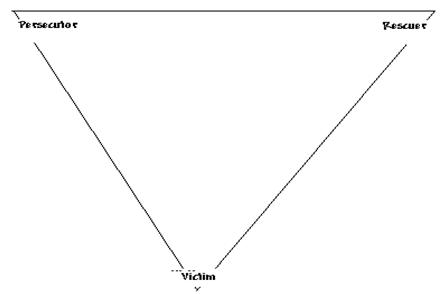
Each of us has a familiar position and this we learned first within our families. Though we have a role we identify most with, we rotate through the other positions to go around the triangle many times every day.
It’s difficult to see others and ourselves as victims when we are care taking, however both Rescuer and Persecutor are the two extremes of Victim.
Notice that the Persecutor and Rescuer are on top of the triangle, in these places we interact from a one-up position. We interact as better, stronger, more powerful and knowledgeable than the Victim does. The Victim being below us adopts a feeling of being looked down upon and builds resentment, which in turn means retaliation gets justified. The Rescuer being mediator or problem solver then gets involved too.
In western cultural terms; Rescuers may be seen as a feminine aspect. Persecutors, conversely, being about power and assertiveness may be regarded as masculine. When these qualities aren’t acknowledged and claimed, we repress them into our unconscious and they get acted out in unconscious and irresponsible behaviours in our Drama Triangle. When we acknowledge all of ourselves, good and bad, our shadow and light, our masculine and feminine we can begin to shift the destruction we carry within.
When we suppress our problem solving abilities, our self-responsibility and our power of assertion action, we become Victim. When we see ourselves as mediators or caretakers, but disregard our duty of self-care and boundaries, we become Rescuer. Persecutors repress their caring and nurturing qualities to solve everything through anger, abuse and control. As such by repressing inner aspects of themselves they become Victims.
The Victim,
The Victim position is the key role in the Triangle because it is the game around which all others revolve. Victims continually look for someone else or something to blame for things not working for them.
Listen for: everyone and anyone does it to me; you, they, the government, mother, father, boss, spouse, children, etc. do it to me; poor me. Its’ not my fault, I’ve had a difficult life, I have bad luck, I can’t, I don’t know how to etc.
Whenever we ask another to lie to protect us from the consequences of our own lies, we play Victim and force them to Rescue us.
Each of us at some time may have these feelings. However, we pick ourselves up, do something different. Whereas Victims don’t learn.
We live in Victim societies where Victim equals Poor Me. We get to feel oppressed, helpless, hopeless, powerless and ashamed. We get to look for Rescuers that help with our negative feelings. We also get to blame from here, its not out fault, its them, the others… all self responsibility is absolved and that at times can feel real good…
If we stay in the Victim position, we block ourselves from making our own decisions, solving our own problems, gaining pleasure and understanding ourselves. Victims are convinced of their incompetence and live in a shame spiral that becomes their identity.
The only way out from this position is to take responsibility.
It is also difficult for someone in Victim stance to take responsibility for the way they hurt others. In their mind, others deserve what they get because they’ve had to fight for survival and as they’ve been treated unfairly, somebody is going to have to pay.
Victims deny their problem solving abilities and their own potential for self-generated power, preferring to see themselves as too fragile to handle life.
Holding onto the idea that they are weak, vulnerable or defective, Victims adopt an attitude of can’t do, this then ‘forces’ them to be on the lookout for someone to help them.
Unfortunately this doesn’t stop them from feeling resentful about their dependency as they get fed up with being low on the Totem pole and find ways to get even. Moving into persecutor means sabotaging any efforts made to rescue them, playing ‘Yes But,’ whenever help is offered. Or, ‘Yes, but that won’t work because…‘
Another response is a shift into the Persecutor role, to blame, shame and or manipulate others into taking care of them. If anyone in the triangle changes role, the others change too.
There are two basic Victims types, Pathetic Victim, and Angry Victim. Pathetic Victim plays for pity, using “poor me” looks and the language of self-pity. Angry Victim pretends to be powerful, using anger and I won’t let you do it to me, Look what you did to me, You’re not going to do that to me again, or You’re a bad person language.
Both Victims are looking for someone to blame for their feelings and for their lives not working out. They are also looking for a Rescuer, someone to hook into taking care of them and their responsibilities. To do this Victims work hard to manipulate to get what they want using blame, shame and guilt. When they find someone they can blame for their unfulfilled lives (and they will), Victims see this person as their Persecutor.
When the Persecutor believes the Victim (and they will) that they should accept blame or shame and feeling guilty they will then attempt to fix the situation, these fixes means they move from Persecutor and into Rescuer. Victims use blame to manipulate others into Rescuing; if they can get you to feel guilty, you will Rescue to stop being or feeling a bad person or Persecutor. Once guilty and Rescuing the Victim, you as Rescuer are now firmly hooked into the Triangle. And we’ve got us a game for life.
The Rescuer,
Is the Let Me Help You, Good guy, cavalry role, they will Rescue even when they really don’t want to because they feel guilty if they don’t. Rescuers regard themselves as enablers, protectors, mediators and as problem solvers. (beware).
They give permission to fail and deep down know they will fail in any rescue attempts.
Rescuers hold the shadow mother, the co-dependent way we think of as the smothering mother, a perverted feminine aspect of the desire to encourage, protect and help. Rescuers have no problem identifying as helpers, being proud of themselves as caretakers and fixers. Making themselves indispensable becomes a way of avoiding their own abandonment fears and provides the validation they need. They sincerely believe in the goodness of being helpful caretakers and deny any negative consequences of their helping or how they too can end up as victims. Part of rescuing is that it is an unconscious wish for self importance, taking care of others may be the only way a Rescuer knows how to connect or feel worthwhile as their fear is that nobody is there for them. They compensate for this by being there for others and end up encouraging dependency. Unfortunately, Rescuing has high social status and rewards abound for selfless acts of Rescue.Rescuers are blind to the dependency they foster when they take care of those they insist on Rescuing. They send disabling messages to all involved and are convinced that the Victim is incapable, inadequate or defective. All this does is to reinforce the need for constant rescue and it becomes the Rescuers job to keep the Victim propped up…
It’s difficult for Rescuers to regard themselves as Victims even at the point that the Victim moves into Persecutor. Rescuers move into Victim wearing martyrdom and depression; After all I’ve done for you… This is the depressed aspect of Rescuing. Having a Victim is essential for Rescuers to maintain being and needed, there will always be one person in every Rescuers life who is sick, fragile, poor me and needy.
Though Victims are supposedly pitiful and incapable, they can Rescue from their low position, you’re the only one who can help me, because you’re so talented, clever, smart and know just what to do…
The Persecutor are the Its All Your Fault people, If it weren’t for you, I wouldn’t have to… they set strict limits, blame, bully their Victims, criticise, are the Critical Parent, are fuelled by anger and recognisable by their rigid, authoritarian ways.
Look out for preaching, blaming, lecturing, interrogating and attacks.
Persecution is the role most often denied and the most often justified as defence.
If culturally the Rescuer is the shadow mother principle, Persecution is the shadow father principle. The Persecutor role is a perversion of fathering and instead of nurturing, attempts change by force. Persecutors being shame based have repressed or learned to overcome their feelings of low esteem and hide these with anger, being uncaring and instead meet their needs through over-powering others, being authoritarian, controlling and punishing.
Persecutors like Rescuers need someone to help, however, they also need someone to blame. Persecutors deny their weaknesses in the same way Rescuers deny their own needs. By denying their own weaknesses they need someone they can project their own low esteem onto.
Rescuers and Persecutors both need Victims to keep their place in the triangle.
Persecutors compensate for worthlessness feelings by grandiosity and this compensates for their internal inferiority. This happens as they attempt to compensate for lesser feelings by inflating those they do have, unfortunately not having good feelings in any real felt sense, they over compensate and appear grandiose…
Persecutors believe the world is dangerous and use shame to keep others in their place, to feel safe ‘by getting them before they get me.’
Having a Victim to order or help is essential in order for the Persecutor to maintain an illusion of being superior, since there will always be someone who needs their advice, guidance and strict discipline.
o0o
To get off the Triangle, we must take full responsibility for ourselves and acknowledge our true feelings, even when this is uncomfortable. Being honest is the simplest way to get off the triangle as is taking action about the difficulties we feel about ourselves. As we explore our beliefs we become able to recognise when others hook us or when we hook ourselves into the game and can learn to refuse to play.
To resist Victim, we need to learn how to sit with our difficulties, learn to take responsibility, not immediately turn to others for help and challenge the belief that they can’t help themselves.
Rescuers need to confess their needs of keeping others dependent, that being a rescuer meets their own need of self-worth and learn to meet these needs.
Persecutors need to let go of blame, need to learn how to fulfil their lack of worth and that letting go of control does not create chaos.
To leave the triangle is usually completed through the Persecutor role; as we decide to leave, we are seen as Persecutors by those still in it. Our decision of self-responsibility and telling our truth is seen as us being the bad guy, not wanting to help others any more. As we begin the process of liberating ourselves by self-responsibility and telling our truth, we begin to actualise our Higher Selves and release the possibilities within us.
When you begin checking your true motives and feelings, you will experience uncomfortable feelings and learn to allow others theirs and not to rescue them. This risks you being seen as a Persecutor. Setting boundaries about what you will and won’t do only reinforces this. However, if you continue and they can’t get a game going with you, they will go elsewhere. I‘m assuming you’ll have talked with them about your thoughts, feelings and wanting to behave differently, if they still can’t make the changes for themselves, you may have to let them go.
I wish you well.
 neilbenbow.com
Leave a comment